Rainbow trout are the most stocked and most caught trout in New Mexico, and they are not from here. They are native to North America west of the Rocky Mountains, in Pacific drainages, and they arrived in this state in 1896.
Identification
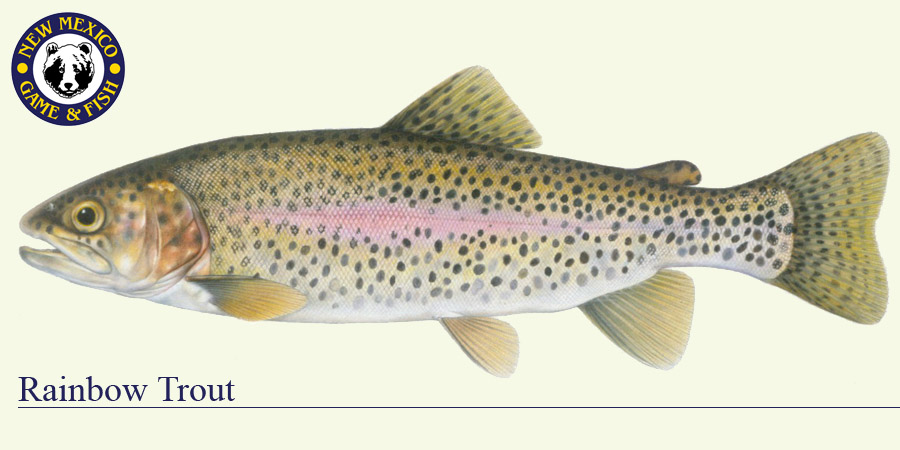
- Small black spots spread evenly from head to tail, including on the tail fin
- A silvery body with a pink or red lateral band
- An olive-green back
- White tips on the dorsal, pelvic and anal fins
- No slash below the jaw
- A slightly forked, spotted tail
Rainbow versus brown. Two marks, both visible in a photograph. The tail: a rainbow’s is spotted and slightly forked, a brown trout’s is nearly square with few or no spots on it. And the spots themselves: a rainbow’s are small, black and round and cover the whole fish, while a brown carries large irregular dark spots plus red-orange spots ringed with pale halos.
Rainbow versus a cutbow. This is the one that matters for the Trout Challenge. Rainbows and Rio Grande Cutthroat Trout interbreed and the offspring are fertile, so a hybrid can carry a faint slash and still be mostly rainbow. The most teachable tell runs the other way: a pure cutthroat has no white tip on any fin. A fish with white fin tips has rainbow in it. Under New Mexico’s rules, though, any trout with red slash marks below the jaw is treated as a cutthroat regardless of what you think it is, and that is a different bag limit.
One mark not to confuse. A rainbow’s white fin tip is a small pale point at the end of the fin. A brook trout’s white edge runs the full length of the leading edge and has a black stripe behind it. Different fish, different mark.
Range and Life History
Native range. North America west of the Rocky Mountains, in Pacific drainages. The strain stocked across the world traces to the McCloud River in northern California, where a federal hatchery began exporting rainbow eggs in the 1870s.
How they got here. New Mexico Game and Fish’s own magazine puts a date on it, citing The Fishes of New Mexico: stocking rainbows from the Northwest “began in 1896 at Bluewater Creek near Grants and Eagle Creek near Ruidoso.” The railroads made it possible. The first big railhead reached Las Vegas in 1879, fry came west from federal hatcheries in milk cans, and the last leg was by horse-drawn wagon or pack mule.
Current New Mexico range. Statewide. Rainbows are the backbone of the state’s stocking program and the fish most New Mexico anglers catch most often. Wild populations also persist from historic stockings.
Spawning. Spring.
Habitat. Rivers, streams, lakes and tailwaters across New Mexico, in cold water.
Diet. Broadly, insects, crustaceans, fish eggs and small fish.
State record. 31 pounds 12.5 ounces and 33.5 inches, from Santa Cruz Lake in 1999, caught by Peter Romero.
Conservation Status
Rainbow trout are secure worldwide and have been introduced almost everywhere trout will live. In New Mexico the conservation question is not about the rainbow. It is about what the rainbow does to the two natives.
Rainbows and Rio Grande Cutthroat Trout interbreed. So do rainbows and Gila trout. The offspring are fertile, which means hybridization does not produce a hybrid population alongside a pure one. It erases the pure one.
New Mexico’s own record shows how long that took to understand. Reporting for 1909 to 1911, territorial game warden Thomas Gable noticed the crossing and approved of it:
“These two varieties cross very readily, so that it is difficult now to find these distinct species… It has become a well-known fact to all students of fish life and culture, that crossing is beneficial.”
Writing in New Mexico Wildlife in 2004, the department’s own former public affairs chief gave the verdict: although Gable saw hybridization as benign, even beneficial, “it helped put the native Gila trout on state and federal endangered species lists years later, and it reduced purebred populations of Rio Grande cutthroat to mere remnants in scattered headwaters.”
Conservation and Management
Nobody restores rainbow trout in New Mexico. What exists instead is a management program aimed squarely at the hybridization problem, and it is more interesting than it sounds.
New Mexico is converting its hatchery rainbow production to triploid, meaning sterile, fish. A triploid trout carries three sets of chromosomes instead of two, because the eggs were shocked during development. It is not genetic engineering. The fish grows and fights like any other rainbow. It simply cannot reproduce, so it cannot cross with a cutthroat.
The Glenwood hatchery raises only female triploid rainbows, in the department’s words, “to be stocked in waters where interbreeding with native fish is not desired.” The Red River hatchery, the state’s largest at about 1.7 million rainbows a year, is being converted for the same reason. Not every hatchery has been, so it is not true that every stocked rainbow in New Mexico is sterile.
Two gaps remain, and Game and Fish has named them itself. Private landowners may stock their own rainbow trout, and the state does not require those fish to be triploid. And the wild rainbow populations already established here are unaffected by any hatchery policy. Those are the fish still hybridizing.
Rainbow trout are stocked in waters all over New Mexico, and New Mexico Game and Fish publishes a stocking report every week. That report is the fastest way to find out what went in near you and when.