Brown trout are the only fish on these five pages from another continent. They are native to Europe, western Asia and North Africa, they reached New Mexico soon after 1896, and they are now the state’s most widespread trout.
Identification
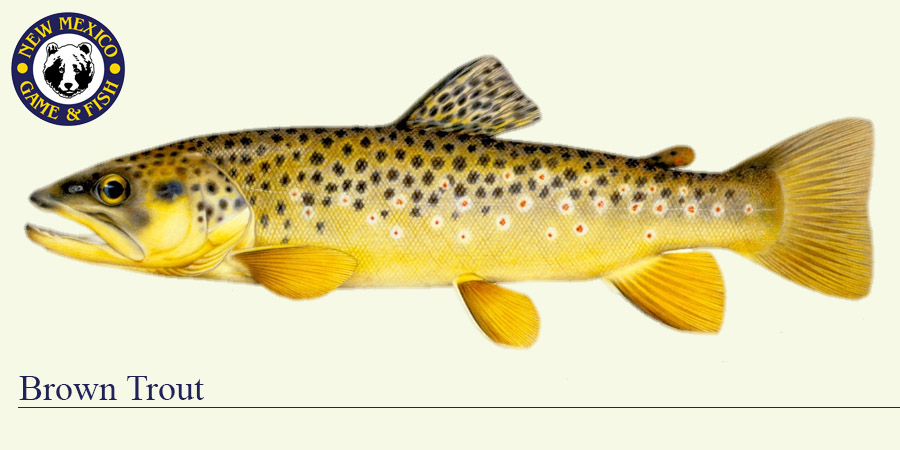
- Large dark spots, often irregular, plus red-orange spots ringed with pale blue halos
- Few or no spots on the tail
- A nearly square tail, or only slightly concave
- A golden-brown body with a yellow abdomen
- A large mouth; the jaw extends well past the rear margin of the eye
- No slash below the jaw
Brown versus rainbow. For a beginner this is the most common mix-up in New Mexico, and two marks settle it, both visible in a photograph.
The tail. A rainbow’s is spotted and slightly forked. A brown’s is nearly square and carries few or no spots at all.
The spots. A rainbow’s are small, black, round and everywhere. A brown’s are large and irregular, and mixed in with them are red-orange spots with pale halos. No other trout in New Mexico has red spots with halos except the brook trout, and brook trout have worm-track vermiculations on the back that nothing else here has, so those two never get confused.
If you still are not sure, look at the body and the mouth. A rainbow is silvery with a pink stripe. A brown is golden-brown with a yellow belly and a notably big jaw that runs past the back of the eye.
Range and Life History
Native range. Europe, western Asia and North Africa.
How they reached America. Brown trout arrived in the United States in 1883, when eggs from a German fishing society were shipped to American hatcheries. The first recorded planting was in Michigan in 1884.
How they reached New Mexico. Soon after the 1896 rainbows. New Mexico Game and Fish’s own magazine, citing The Fishes of New Mexico, lists “brook trout from the southern Appalachians, brown trout from Europe” as following the first rainbow stockings. By territorial game warden Page Otero’s first report, filed after his 1903 appointment, the Pecos already held five trout species: native Rio Grande Cutthroat, rainbow, brook, brown and Dolly Varden.
Current New Mexico range. The state’s most widespread trout. Unlike rainbow trout, brown trout reproduce naturally here.
Spawning. Fall, beginning in New Mexico around early October. The female digs a redd in clean gravel at the tail of a pool or the head of a riffle and covers the eggs with a sweep of her tail. Redds show up as pale, freshly cleaned patches of gravel.
Habitat. Coldwater streams with gravel to cobble bottoms and good cover. Browns tolerate warmer water and lower dissolved oxygen than brook trout, which is part of why they hold water the other species cannot.
Diet. Aquatic and terrestrial insects, and large brown trout take other fish.
State record. 20 pounds 4 ounces and 34.5 inches, from the Chama River in 1946, caught by C.T. Colgrove. It is the oldest of New Mexico’s five trout records and it has stood for eighty years.
Conservation Status
Brown trout are secure and established worldwide. Nobody is working to restore them, here or anywhere.
In New Mexico the concern runs the other way. Brown trout displace Rio Grande Cutthroat Trout in the streams they share, primarily by outcompeting them for food. The Rio Santa Barbara is a local example: browns have taken it over, and cutthroat persist, if at all, only in the uppermost reaches.
That said, brown trout are also a genuine and popular wild fishery in northern New Mexico, and no one is proposing to remove them from the rivers where they belong. The state’s approach is targeted, not general.
Conservation and Management
Two things belong on this page, and neither is restoration.
Walk around the redds. This is the most useful thing a brown trout page can carry, because New Mexico closes no water for the fall spawn. There is no law protecting a redd here. It is on you. Researchers found that a single wading over a redd close to hatching killed up to 43 percent of the eggs and pre-emergent fry. From early October through the winter, watch for clean pale gravel at the tail of a pool or the head of a riffle, and step somewhere else.
Habitat work on brown trout water. Our sister chapter, Enchanted Circle Trout Unlimited, has run the Cimarron River Trout Habitat Project across 9 miles of river through Cimarron Canyon State Park and the Colin Neblett Wildlife Area, in three phases at roughly $24,000, with the Cimarron Watershed Alliance, New Mexico Game and Fish, the NMED River Stewardship Program, Oxbow Ecological Engineering and KC-MC Services. It is their longest and most impactful habitat project. It is habitat work on water that browns occupy, which is a different thing from brown trout restoration, and worth saying plainly.
Where brown trout share water with natives, the state takes the limit off. Twenty New Mexico waters carry an unlimited bag on brown, rainbow and brook trout specifically to protect Rio Grande Cutthroat and Gila trout.
Brown trout are legal game across most New Mexico trout water under the general limits, but individual reaches carry their own rules, including catch-and-release stretches where a brown has to go back. Check the reach in the current New Mexico Fishing Rules and Info booklet before you keep one.