Brook trout are not trout. Salvelinus fontinalis is a char, the same genus as lake trout and bull trout and a different genus from every other fish on these five pages. They are native to eastern North America, and the New Mexico stock came from the southern Appalachians in the 1890s.
Identification
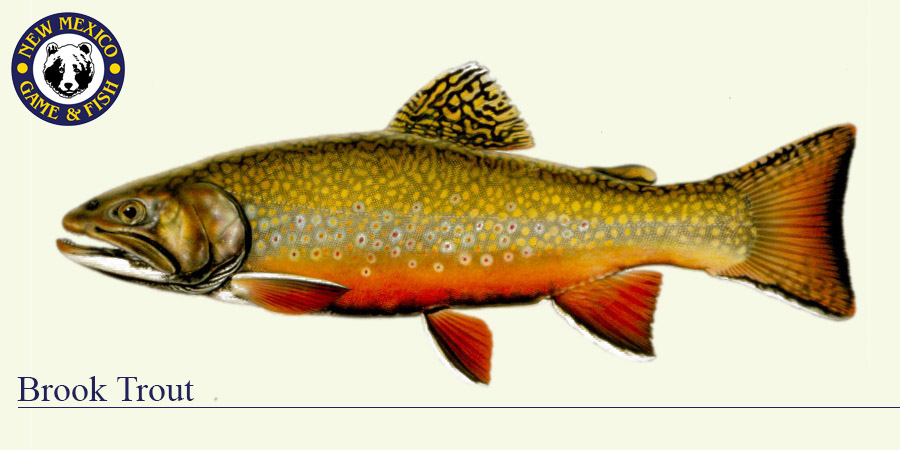
Brook trout are the easiest of New Mexico’s five to identify, because being a char shows. Three marks give it away, and any one of them alone is enough.
- Vermiculations. Dark wavy worm-track lines across the back and the dorsal fin. No other New Mexico salmonid has them.
- Light spots on a dark background. Every true trout in New Mexico wears dark spots on a light body. Char reverse it. That is the taxonomic difference showing up as something you can see.
- A bright white leading edge on the pelvic, anal and pectoral fins, backed by a narrow black stripe. Maine’s fisheries agency notes it extends onto the tail as well.
Supporting marks: red spots ringed with pale blue halos along the sides, a squarish tail (which is where the nickname “squaretail” comes from), an olive to dark back, and orange-red flanks in the fall.
The one trap worth heading off. A brook trout’s white fin edge and a rainbow trout’s white fin tip are not the same mark, and beginners conflate them constantly. The brook trout’s is a continuous white stripe running the full length of the leading edge with black immediately behind it. The rainbow’s is a small pale point at the very end of the fin, with no black stripe. If you can see black behind white, you are holding a char.
Red spots with halos also appear on brown trout, which is the only other place you will see them here, but a brown has dark spots on a light body and no vermiculations. There is a more technical check involving where the teeth sit on the roof of the mouth, but it means handling a fish you are about to release. The three marks above do the job from a photograph.
Range and Life History
Native range. Eastern North America. New Mexico Game and Fish’s own magazine, citing The Fishes of New Mexico, is specific about the stock that came here: brook trout from the southern Appalachians.
How they got here. The 1890s, soon after the first rainbow stockings in 1896. Brook trout also open New Mexico’s hatchery history. When the state bought the site for its first hatchery at Lisboa Springs near Pecos in 1921, the first eggs to arrive in the troughs that December were brook trout eggs.
Current New Mexico range. High-elevation streams and lakes in the Sangre de Cristo, Jemez and San Juan mountains. Game and Fish’s own characterization is worth quoting: brook trout are “relatively uncommon in New Mexico and are typically found in smaller, less accessible streams.”
Size. New Mexico Game and Fish publishes no typical size for brook trout here, and figures from eastern and northwestern states describe different fish in different water. What western fisheries agencies do report is a general property of the fish. Brook trout outside their native range spawn extraordinarily well, and in small water that runs into a hard ceiling. Wyoming Game and Fish puts it about as plainly as an agency can: “Because brook trout can easily overpopulate and stop growing, regulations for their harvest are very liberal.” Washington’s fisheries agency describes an overrun lake as dense populations of slow-growing trout with large heads and skinny bodies.
Spawning. Fall, typically late October into November and in New Mexico as late as early December, at water temperatures around 40 to 50 degrees. Brook trout are obligate groundwater spawners: the female digs her redd over an upwelling spring or at the tail of a pool, where clean water moves up through the gravel.
Habitat and temperature. Cold, clear, well-oxygenated water. Two state agencies put the preferred band differently. Washington’s Department of Fish and Wildlife says about 53 degrees or less. Maine’s Department of Inland Fisheries and Wildlife says 50 to 65. They agree on the part that matters in New Mexico: brook trout are the least heat-tolerant of the five, which is why you find them highest.
Diet. Opportunistic. Aquatic insects and smaller fish.
State record. 5 pounds and 21 inches, from Hidden Lake in 1996, caught by Jack Campbell.
Conservation Status
Brook trout are secure across their introduced range in the West. In their own home range in the eastern United States they are the imperiled native, squeezed out of Appalachian headwaters by introduced rainbows and browns. Here, the roles are exactly reversed.
In New Mexico they displace Rio Grande Cutthroat Trout in the streams they share. Being a different genus, they cannot interbreed with them, so they take the food instead, and New Mexico Game and Fish says exactly that: brook and brown trout “often compete with RGCT for food.” In a 2007 study of Colorado streams holding greenback cutthroat, a close relative of our own fish, researchers found the displacement runs through a bottleneck on recruitment: the eggs and juveniles do not survive.
Brook trout did not do anything wrong. People put them here on purpose, in good faith, to fix a problem people had caused. That is worth remembering on a page that goes on to describe removing them.
Conservation and Management
For brook trout in New Mexico, management means removal, and this page should say so in those words.
Twenty New Mexico waters, called Red Chile or Native Trout Conservation Waters, carry no bag limit at all on brook trout, specifically so that anglers will take them out of water where native Rio Grande Cutthroat Trout and Gila trout are being protected. In those twenty waters, keeping every brook trout you catch is legal, unlimited, and exactly what the state is asking you to do.
It is encouraged, never required. New Mexico has one mandatory-kill rule and it is northern pike at Eagle Nest Lake, not brook trout anywhere. If you would rather release them, that is your call.
Where a stream sits above a barrier, the standard method is mechanical removal by crews rather than by anglers, followed by restocking native fish. That is how a cutthroat population gets its water back.
The twenty waters are listed by name in the current New Mexico Fishing Rules and Info booklet, under Red Chile (Native Trout Conservation) Waters. Two things to read there before you fish them: the tackle restrictions, which are tighter than the general rules, and the consumption advisories, because Cabresto Lake carries one that covers brook trout.