The Rio Grande Cutthroat Trout is New Mexico’s state fish and the southernmost cutthroat subspecies in North America. It is native to the Rio Grande, Canadian and Pecos basins, from southern Colorado through New Mexico, and it is the species this chapter’s conservation work is built around.
Identification
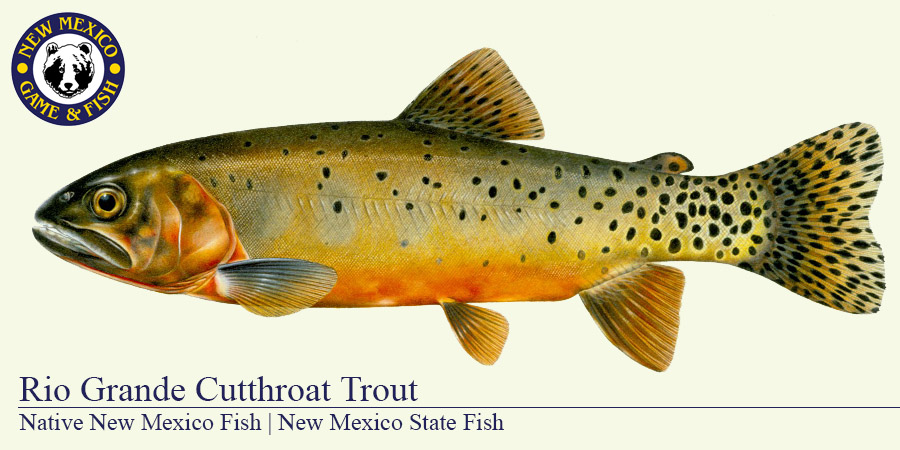
- A red or orange slash beneath the jaw
- Large, sparse spots that crowd toward the tail and thin out near the head
- Brassy or golden sides, a green to bronze back, a crimson-orange belly
- No white tip on any fin
- The upper jaw extends past the rear margin of the eye
Telling a cutthroat from a cutbow. Start with the honest part: a genetically pure cutthroat cannot be confirmed by eye. Rio Grande Cutthroat Trout and rainbow trout interbreed freely, the offspring are fertile, and a cutbow usually still carries a slash. What you can do is read the odds, and one mark does most of the work.
White fin tips are the giveaway. The Utah Cutthroat Slam guide, a Utah Division of Wildlife Resources and Trout Unlimited program, puts it plainly: a pure cutthroat “should not have a white tip to any of their fins.” A cutbow typically shows white tips on the dorsal, pelvic or anal fins while still wearing a slash. It is the single most teachable tell and it shows up in a photograph.
Back it with the spot gradient. Cutthroat spots are larger, sparser, and gather toward the tail. Rainbow spots are finer and spread evenly from head to tail, including onto the tail fin, and a cutbow tends toward that even spread. A silvery body with a strong pink lateral band points to rainbow influence. A pure Rio Grande Cutthroat Trout is brassy gold with a crimson-orange belly.
The slash itself is weak evidence. Cutbows usually have one, just fainter. Faintness is suggestive, not diagnostic. There is a more reliable external key, a small cluster of teeth at the base of the tongue that cutthroat have and rainbows lack, but checking it means putting your fingers in the mouth of a fish that is going back in the water. That is why biologists use genetics instead.
One thing not to confuse: a white fin tip is a small pale spot at the end of a fin. A brook trout’s white leading edge runs the length of the fin and has a black stripe behind it. They are not the same mark.
And the practical answer, because the state has already settled it. New Mexico’s rule is not “what species do you think it is.” It is that any trout with red slash marks below the jaw is considered a cutthroat, which drops the bag limit from five to two. In most cutthroat water you are releasing it anyway. When in doubt, it is a cutthroat.
Range and Life History
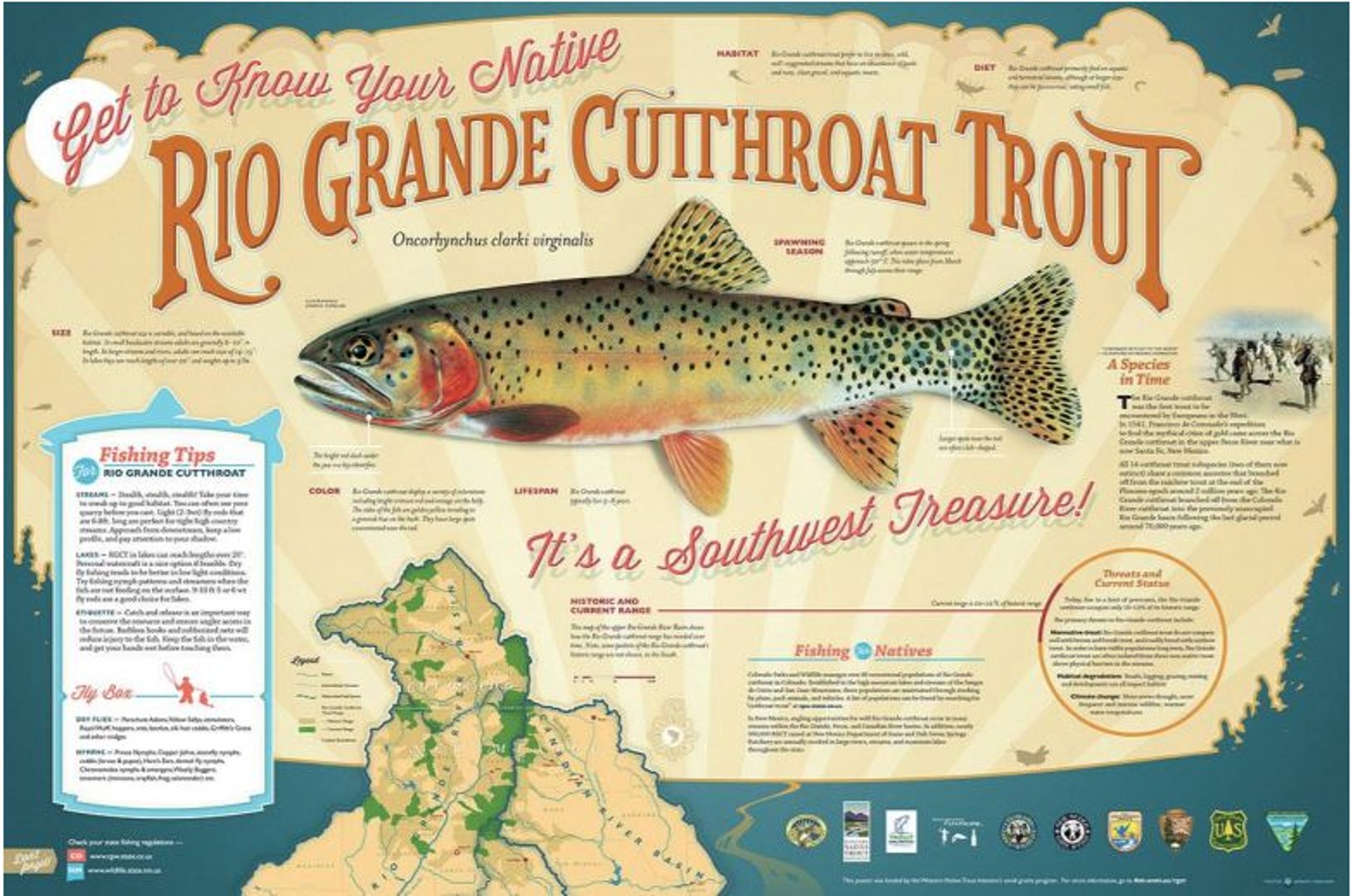
Native range. The Rio Grande, Canadian and Pecos basins, southern Colorado through New Mexico.
Current New Mexico range. About 12 percent of that historic range. More than 120 conservation populations remain range-wide, over 80 of them in New Mexico, concentrated in the Rio Costilla, the upper Pecos and the Jemez.
Size. Typically 10 to 12 inches in New Mexico. In small headwater streams, 6 to 10 inches is normal.
Spawning. Spring, after runoff, triggered as the water approaches 50 degrees.
Habitat. High-elevation headwater streams and lakes. Cold water, and sensitive to both warming and sedimentation.
Diet. Aquatic and terrestrial insects. Larger fish take other fish.
State record. New Mexico’s cutthroat trout record is 10 pounds 2 ounces and 24 5/8 inches, from Latir Lakes in 1981, caught by Elias Mierra. New Mexico Game and Fish lists it as “Cutthroat Trout” without naming a subspecies.
Conservation Status
Rio Grande Cutthroat Trout have never been listed under the Endangered Species Act. They were petitioned in 1998, found warranted but precluded in 2008, which made them a candidate species, found not warranted in 2014, and found not warranted again on December 9, 2024.
What threatens them is not one thing. Rainbow trout hybridize with them. Brook and brown trout outcompete them. The populations that remain are small, isolated from one another, and mostly sit in headwaters at high wildfire risk.
Conservation and Management
The US Fish and Wildlife Service credited the Rio Grande Cutthroat Trout Conservation Team for the 2024 not-warranted finding, a range-wide partnership of state and federal agencies, tribes and nongovernmental organizations across New Mexico and Colorado. Trout Unlimited is one of them. The underlying conservation agreement has been in force since 2003 and was renewed in 2013 and again in 2024.
The tools are barriers to keep non-natives out, mechanical removal above those barriers, duplicating at-risk populations so one fire cannot erase a lineage, and habitat work. Seven Springs Hatchery in the Jemez holds the pure Rio Grande Cutthroat Trout broodstock and has raised more than 72,000 fish since 2002.
Our sister chapter to the north, Enchanted Circle Trout Unlimited, has put over $40,000 into cutthroat restoration and habitat work on the Rio Costilla, Columbine Creek, the Rio Hondo tributaries and the Rio San Antonio. We are their partner on the Red River Trout Project and Fishing Park.
The Truchas Chapter’s own stated conservation focus is this fish: securing the populations that remain and restoring the species to habitat it used to hold. That, plus watershed work, river cleanups, Trout in the Classroom, and advocacy in northern New Mexico.
Where to find Rio Grande Cutthroat Trout, and which rules apply on which water, is set out reach by reach in the current New Mexico Fishing Rules and Info booklet. Check the water you plan to fish before you go. Most of the cutthroat reaches carry their own limits and tackle restrictions, and they are not the general rules.