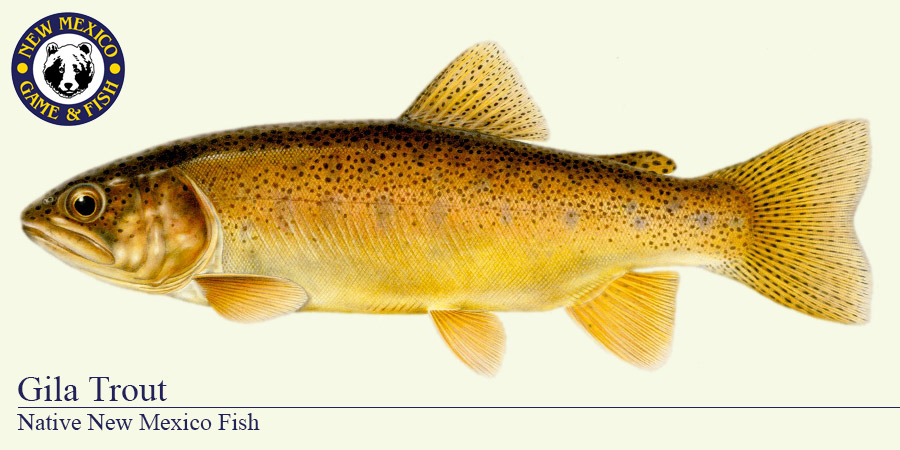
Gila trout are native to the mountain streams of the Gila, San Francisco and Verde basins in New Mexico and Arizona. They are among the rarest trout in North America and the only fish on these five pages that has been listed under the Endangered Species Act.
Identification
Start with geography, because it settles most cases before anyone looks at a fish. Gila trout occur only in the Gila and San Francisco drainages of southwestern New Mexico. Rio Grande Cutthroat Trout occur only in the Rio Grande, Canadian and Pecos basins in the north. They do not overlap in the wild. If you are standing in the Gila, it is not a Rio Grande Cutthroat. If you are standing in the Pecos, it is not a Gila.
- A yellow slash below the jaw on larger fish
- Small, profuse spots confined to the upper half of the body
- Iridescent gold sides shading to copper on the gill covers
- A dark olive-green back and a golden-yellow belly
- A faint salmon band, strongest at spawning
Gila versus rainbow. Gila spots stay on the upper body. Rainbow spots run the full body and out onto the tail fin. A Gila is gold and copper with only a faint salmon wash; a rainbow carries a distinct pink stripe. And a larger Gila has a yellow throat slash, which a rainbow never does.
Gila versus cutthroat. Slash color is the whole test. Yellow for Gila, red for cutthroat. That difference is legal, not cosmetic: New Mexico’s rule is that any trout with red slash marks below the jaw is treated as a cutthroat, which is a different bag limit. Spot pattern backs it up. Gila spots are small and profuse; cutthroat spots are large and sparse and crowd toward the tail.
The real identification risk here is not another species, it is a Gila and rainbow hybrid. The two interbreed and the offspring are fertile, which is exactly why recovery work is built around barriers that keep rainbows out. As with cutthroat, a photograph cannot confirm that a fish is genetically pure.
Range and Life History
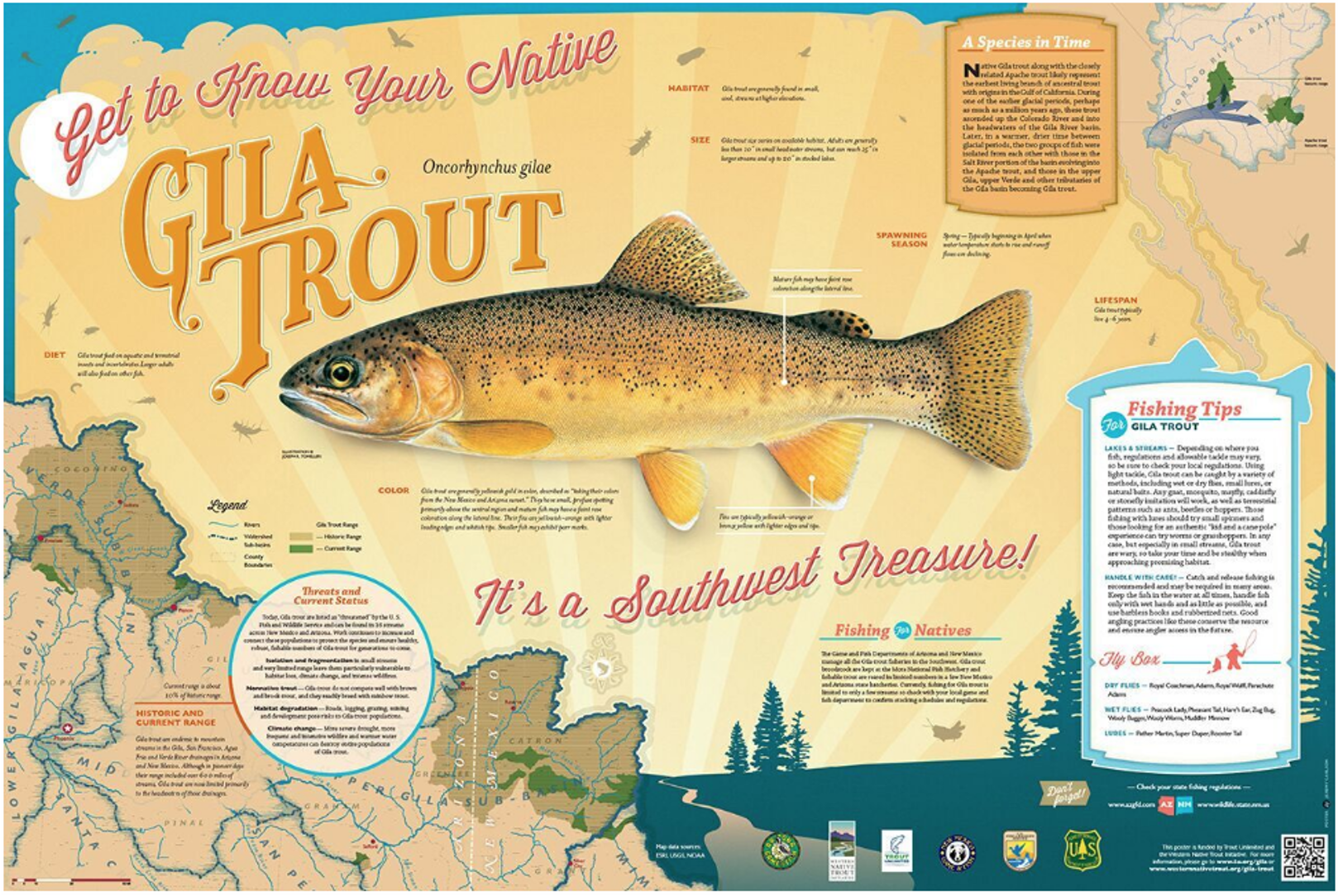
Native range. Mountain streams of the Gila, San Francisco and Verde basins in New Mexico and Arizona.
Current New Mexico range. The Gila National Forest, including the Gila and Aldo Leopold Wilderness areas. Pure populations now hold 21 streams in New Mexico and four in Arizona, up from eight populations across roughly 30 miles of stream in 2014.
Lineages. Every restored population traces to one of five remnant lineages: Main Diamond, South Diamond, Whiskey Creek, Iron Creek and Spruce Creek. That is why a single fire in a single canyon is a species-level event.
Size. Rarely over 12 inches. Over 15 inches where habitat allows.
Life span. Sexually mature by age three, living four to six years.
Spawning. Early spring, as water temperatures rise.
Habitat. Coldwater mountain streams with undercut banks and fallen branches for cover. In drought, pools fed by groundwater seeps are the refuge, and those pools are often what a population survives a fire in.
Diet. Insects.
State record. 4 pounds 8 ounces and 20 inches, from the Gila River in 2007, caught by Todd Polak.
Conservation Status
Gila trout were listed as endangered in 1967 and downlisted to threatened in 2006. That downlisting is a real conservation win and it is why a limited, permitted fishery exists at all.
Wildfire is the defining threat, and not because the fire kills fish directly. Ash and debris flowing off a burn scar into a small stream can erase an entire population in one storm. The 2012 Whitewater-Baldy Fire is the reference event. In July 2026, ahead of flooding off the Sacaton burn scar, crews evacuated 78 Gila trout from Iron Creek and moved them to the Mora National Fish Hatchery in northern New Mexico.
Conservation and Management
Recovery is run by the Gila Trout Recovery Team, which New Mexico Game and Fish names as itself, the US Forest Service, the US Fish and Wildlife Service, the University of New Mexico, the Arizona Game and Fish Department, and Trout Unlimited.
The model is consistent: build or use a barrier, remove the non-native trout above it, then restock from one of the five lineages. It is slow, it is expensive, and it is the reason there are 21 streams instead of eight.
Much of the hands-on work belongs to our sister chapter in the south, the Gila/Rio Grande Chapter of Trout Unlimited (#780) in Las Cruces. They have spent years rebuilding the Willow Creek watershed after the 2012 fire, including a permanent downstream barrier to hold the line against non-natives. On Little Turkey Creek in October and November of 2023 they put in more than 70 in-stream structures and planted roughly 750 willows in twelve days. Gilita Creek is now underway.
The northern New Mexico connection is the Mora National Fish Hatchery, which is where the Iron Creek fish went.
Gila trout can be fished legally on a short list of named waters, and doing so requires a free Gila Trout Fishing Permit on top of a New Mexico fishing license. The waters, the permit and the rules are in the current New Mexico Fishing Rules and Info booklet. Read the entry for the specific stream, because the rules are not the same on all of them.