
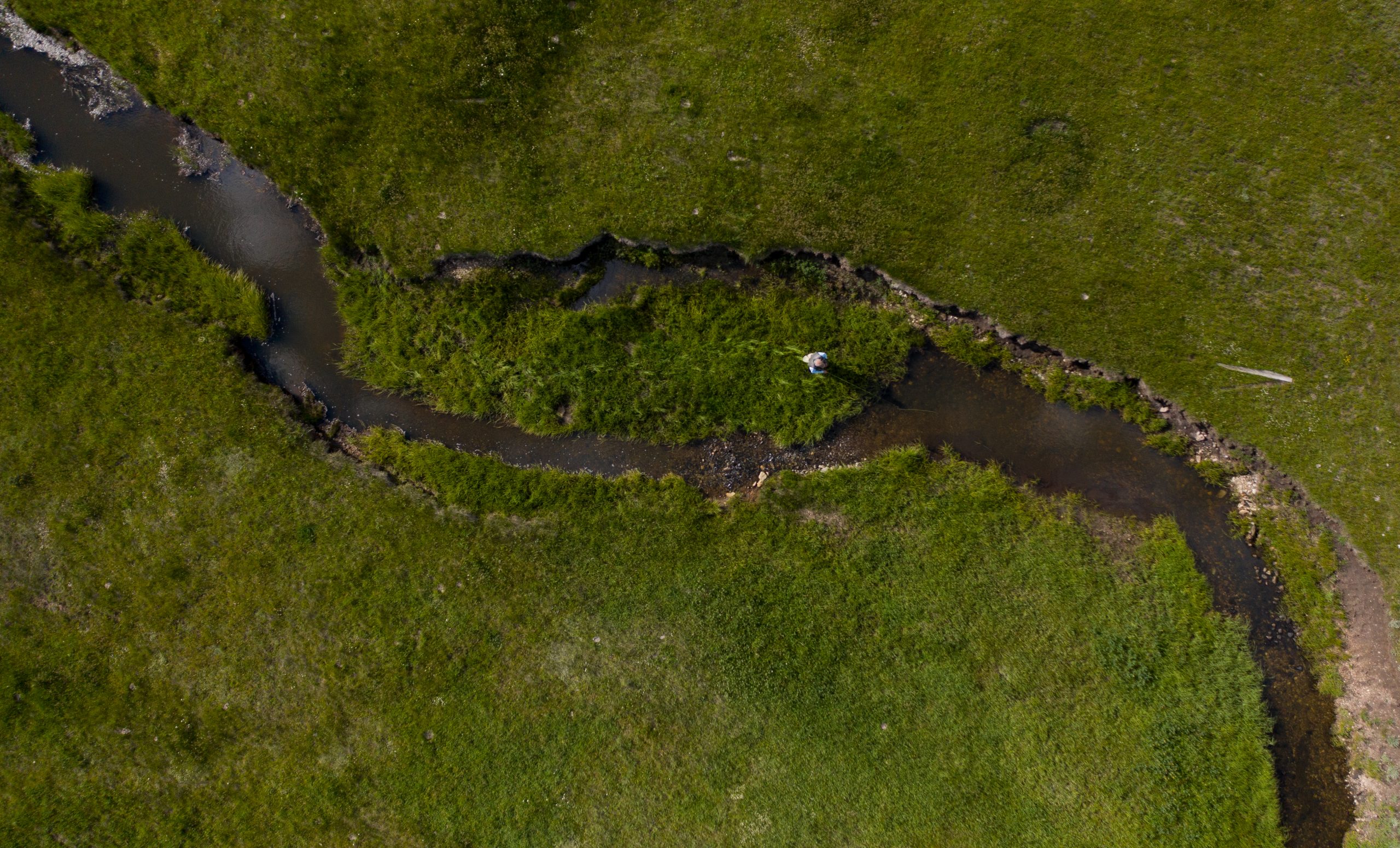
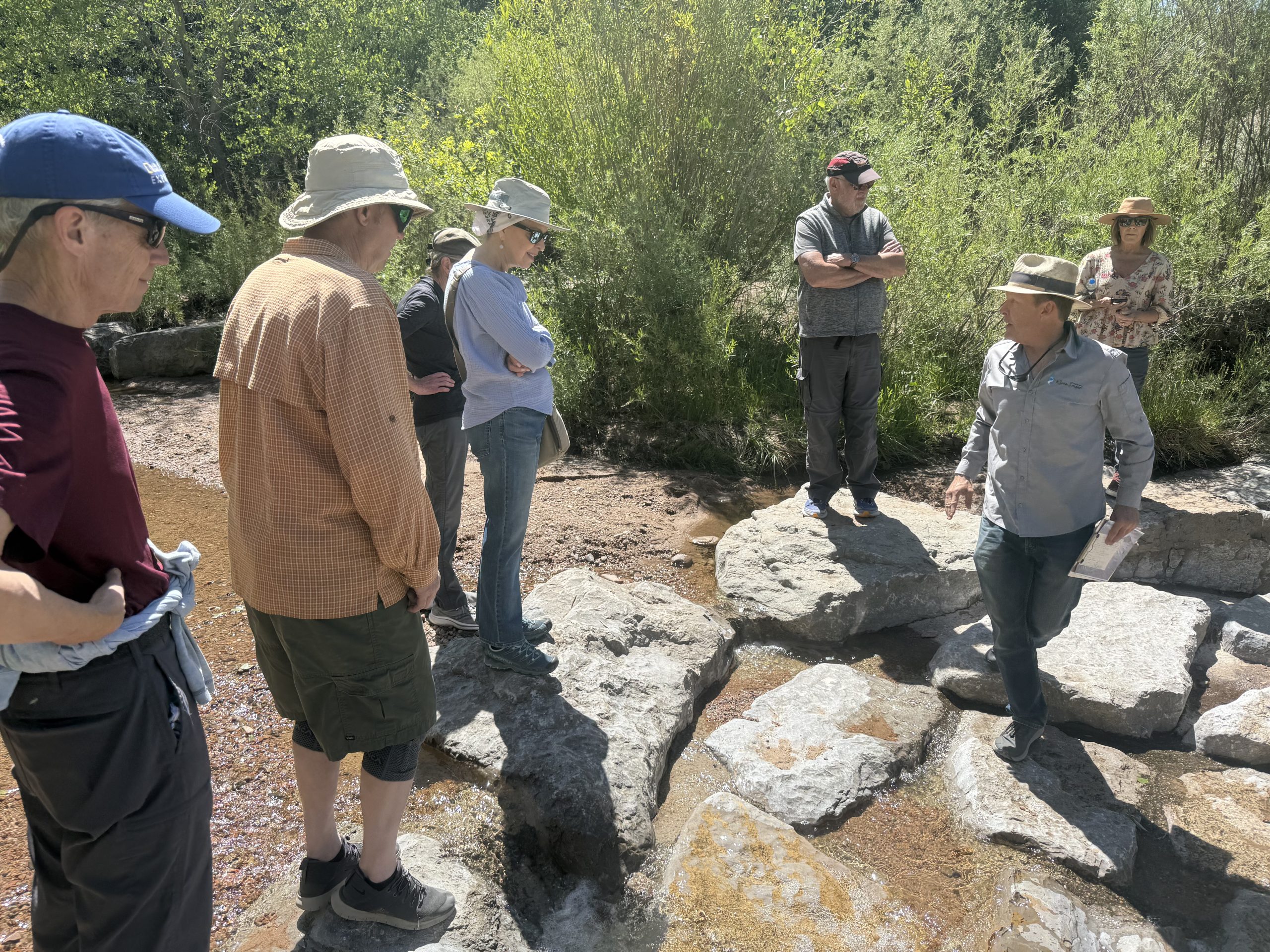
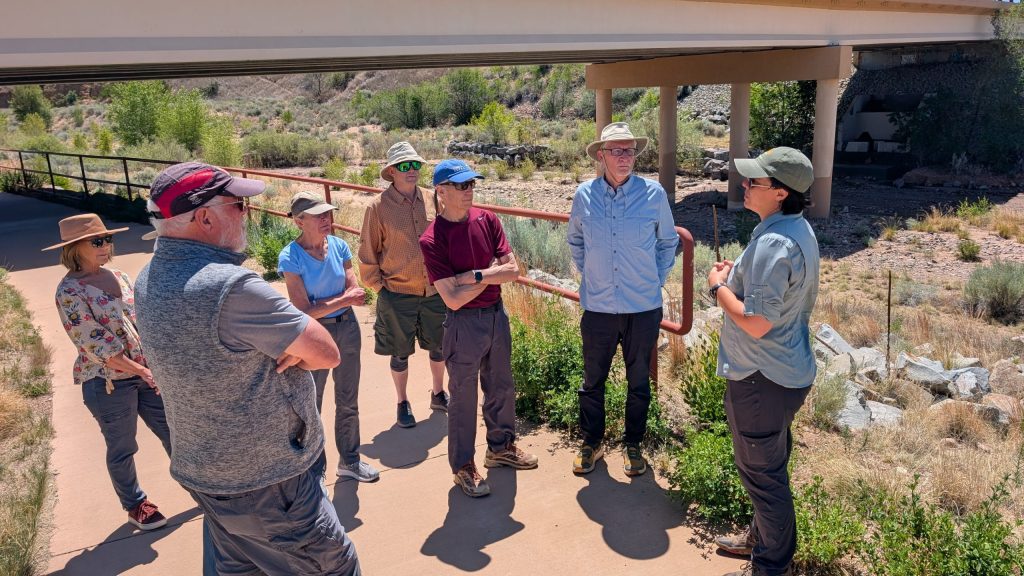
On May 30, 2026, members of the Truchas Chapter gathered for an incredibly informative morning touring the urbanized section of the Santa Fe River. Hosted by Rich Schrader, Director of River Source, and featuring insights on recent Santa Fe County restoration efforts from Mori Hensley, Executive Director of the Santa Fe Watershed Association, the tour offered a deep dive into the history, hard-won successes, and complex future of our local waterway.
The Evolution of a Living River
For millennia, the Santa Fe River has been the lifeblood of this region—from the Tewa and Keres Pueblos of Tesuque and Cochiti to the Spanish settlers who farmed its banks using over 38 historic acequias.
Yet, by 1992, the river was largely ignored, treated as a dumping ground, and severely degraded. Rich Schrader shared striking historic photos from before the River Trail was built, showing cars driving through low-water crossings, collapsing banks scarred by 25-foot erosion asheers, and unstable rock structures.
A turning point came in 2007 when the City and County heavily invested in a unified River Trail vision. River Source assembled a dream team of restoration practitioners—including Bill Zeedyk, Steve Vrooman, Craig Sponholtz, and Van Clothier—to design a stabilizing hybrid framework. Though the initial earthwork in the extreme drought of 2011 left the banks looking alarmingly bare, community collaboration triumphed. Hundreds of volunteers through WildEarth Guardians, River Source, and the Santa Fe Watershed Association planted thousands of willows and cottonwoods, bringing life back to the channel.
Modern Challenges & Collaborative Solutions
The tour highlighted three major modern challenges that require our collective attention:
- The Gradient of Environmental Flow: Thanks to the 2012 Living River Ordinance, the river receives up to 1,000 acre-feet of targeted flow in wet years. However, due to urban geology, that water rarely flows past the Siler Road Bridge before sinking into the ground. East-side residents enjoy a lush riparian zone, while the west side remains largely dry.
- Stormwater still happens during a Megadrought: Decades of urban development neglected to “slow, spread, and sink” water. Today, impervious surfaces cause rapid, destructive stormwater runoff during extreme weather events – like the historic July 2018 storm that dumped 3.5 inches of rain in a single hour. River Source has mapped these critical stormwater outflows to pinpoint severe erosion risks.
- The Threat Downstream: Below the Paseo Real Wastewater Treatment Plant (WWTP), treated effluent has created a thriving, year-round wetland habitat where beavers, deer, and fish flourish. However, a current City proposal aims to pipe about 50% of this wastewater to the Buckman Direct Diversion for return flow credits. This move would drastically dry out the lower Santa Fe River, threatening downstream farmers, wildlife, and tribal communities at Cochiti Pueblo.
Working Together for the Next Chapter
The greatest lesson of the Santa Fe River is that restoration relies on collaboration across traditional boundaries. Moving forward, River Source and its partners will need community voices to advocate for equitable water distribution across the city and to engage in public input processes regarding the return flow pipeline. By tracking river data and showing up for public forums, we can ensure our river remains a living, shared resource for everyone downstream.