The Rio Grande Cutthroat Trout (Oncorhynchus clarkii virginalis) is New Mexico’s official state fish, the southernmost subspecies of cutthroat trout in North America, and the native species the Truchas Chapter of Trout Unlimited exists to protect. In December 2024, the U.S. Fish and Wildlife Service determined that Endangered Species Act listing was “not warranted,” a finding driven by more than two decades of recovery work across federal, state, tribal, and nonprofit partners. That decision is good news. It is not a finish line.
This post is a primer on the species: why it matters, what it looks like, where it lives, and what is being done (and what we ourselves do) to keep it on the landscape.
A native fish with a much smaller map
Rio Grande Cutthroat Trout once swam through the headwaters of the Rio Grande and Pecos River drainages, from southern Colorado down into northern New Mexico, and as far east as the Canadian River. They held the high, cold creeks. They were a working part of these watersheds for thousands of years before European settlement.
Today they occupy roughly 10 to 12 percent of that historic range. The decline traces to the usual list of pressures: drought, water diversions, road and grazing impacts on stream habitat, hybridization with rainbow trout (stocked widely beginning in the late 1800s), and competition from non-native brown and brook trout. Where a stream now holds rainbows or brookies, it usually no longer holds pure cutthroats.
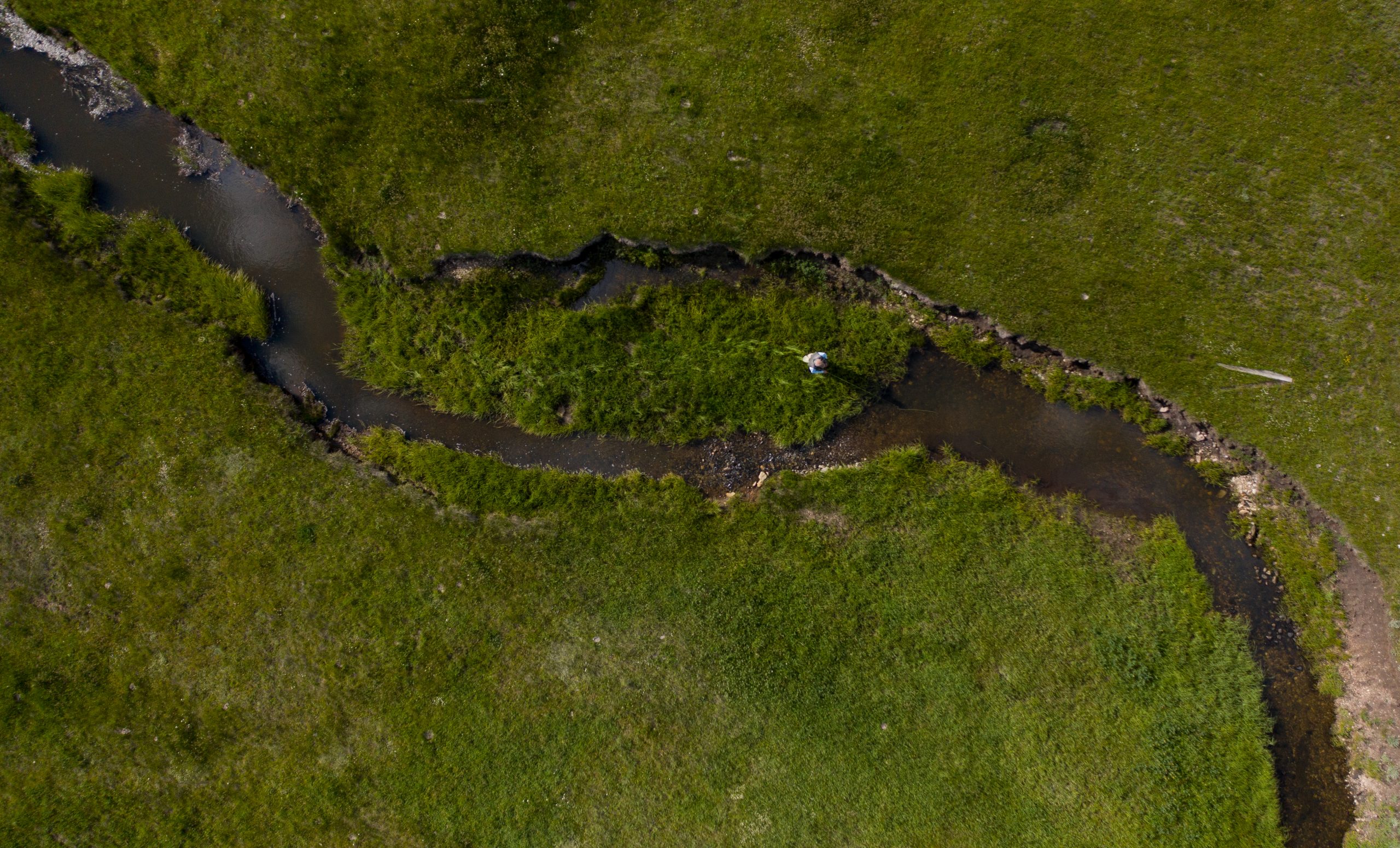
The good news is that the recovery story is local. Almost every remaining genetically pure population lives in a small, isolated headwater segment somewhere across northern New Mexico or southern Colorado. About 100 of those headwater streams still hold them. Several are right here in our service area.
What does a Rio Grande Cutthroat Trout look like?
The short answer for anyone who hooks one and wants to be sure: look under the jaw. Cutthroats are named for the bright red or orange slash mark in the throat folds beneath the lower jaw. That single field mark is the most reliable identifier.
Beyond that, Rio Grande Cutthroats carry irregular spots concentrated behind the dorsal fin (the largest fin on the back) and along the tail, with fewer spots forward. Coloration runs from a golden-yellow flank to a greenish back, with a crimson or orange wash on the belly that intensifies in spawning fish. Size is modest. Most fish in our small, high-elevation creeks run 6 to 10 inches. The occasional stream-resident adult might reach 15 or 16 inches in larger water.
If you land a brightly colored fish in a Pecos Wilderness tributary above 8,500 feet, it is very likely a Rio Grande Cutthroat. Take a quick photo, keep the fish wet, and let it go.
How partners brought the species back from the brink
The 2024 “not warranted” finding rested on more than 20 years of organized recovery, much of it kicked off in 2003 with the formation of the Rio Grande Cutthroat Trout Conservation Team. That team brought together the U.S. Fish and Wildlife Service, New Mexico Department of Game and Fish, Colorado Parks and Wildlife, the U.S. Forest Service, tribes, municipalities, NGOs (Trout Unlimited included), and private landowners. Coordinated, watershed by watershed.
The work itself comes in a few shapes:
- Fish barriers. Small in-stream structures that block non-native trout from moving upstream into cutthroat refugia. A single barrier typically costs around $400,000 to design, permit, and construct.
- Removal and reintroduction. Mechanical and chemical removal of non-native trout above those barriers, followed by reintroduction of genetically appropriate cutthroats.
- Habitat repair. Rock structures that hold gravels, riparian fencing, road decommissioning, and other work on degraded stream reaches.
- Genetic monitoring. Confirming that what comes back is genuinely pure, not a quiet hybrid.
The flagship example is the Rio Costilla Project on the Vermejo and Costilla drainages. Begun in 2002, it has restored Rio Grande Cutthroat Trout to roughly 120 miles of stream, 15 lakes, and a 300-acre reservoir. It is among the largest native fish restoration projects in U.S. history and, by itself, accounts for a meaningful share of the species’ current footprint.
Closer to home, Jack’s Creek (a tributary of the Pecos River about 20 miles upstream of the town of Pecos) is a priority project for the Western Native Trout Initiative and the New Mexico Department of Game and Fish. Work there is aimed at securing the long-term persistence of a core cutthroat population by keeping non-native fish out.
Where can I fish for Rio Grande Cutthroat in northern New Mexico?
The honest answer is: in a lot of small, hike-in water in the Pecos Wilderness and the Sangre de Cristo high country, and in a few designated waters elsewhere. The New Mexico Department of Game and Fish maintains regulations specific to each native cutthroat water, often including reduced bag limits (two fish per day on several Special Trout Waters), artificial-fly-or-lure-only requirements, and single barbless hooks. Some restoration waters, including parts of the Rio Costilla, are closed seasonally to protect spring spawning.
Always check the current Cold Water Regulations before you fish a new piece of water. Then, when you do catch one of these fish, treat it the way you would treat any 200-year-old artifact: quick photo, wet hands, no air time, gentle release.
Why we do this
We say it on the homepage: it all starts with you. Keeping Rio Grande Cutthroat Trout on the New Mexico map is not a single agency’s job. It is the patient, decades-long work of a lot of people in waders and rubber boots, plus the quieter work of writing comment letters, showing up at meetings, and chipping in for the next fish barrier.
The Truchas Chapter of Trout Unlimited is the local home for that work in northern New Mexico. With more than 400 members and a focus on the Sangre de Cristo and Pecos Wilderness cold-water fisheries, we partner on restoration projects, run Trout in the Classroom for the next generation of stewards, and put on community events (the Fly Fishing Film Festival, the Vermejo Park Flyathlon, casting clinics) that turn enthusiasm into action. The 2024 ESA decision tells us this approach works. It also tells us not to ease off. If you live, fish, or care about water in northern New Mexico, our native cutthroat is your fish too. Come help us keep it that way.
