Bryan Ferguson is the Rio Grande Cutthroat Trout Biologist for the New Mexico Department of Wildlife, and on September 9 he spent an hour with us at our monthly Board meeting going through the state of our native trout, watershed by watershed. He took questions the whole way through. He has since sent us his slides, and the short version is that the picture on the Pecos is better than it was three years ago, and it is still fragile.
What follows is his material, in our words. Any error in it is ours.
The baseline
Rio Grande Cutthroat Trout are the southernmost cutthroat subspecies in North America and New Mexico’s state fish. They now occupy roughly 12 percent of their historic range. Bryan named four threats: nonnative salmonids, habitat loss, wildfire, and drought. If you want the full identification and natural history picture, our species profile covers it.
The work is coordinated by the Rio Grande Cutthroat Trout Conservation Team, thirteen signatories across state, federal, tribal and private organizations, with Trout Unlimited as a supporting organization. The first agreement was signed in 2003. Listing under the Endangered Species Act was deemed unwarranted in 2014 and again in 2024. The fish is a Species of Greatest Conservation Need in New Mexico.
Range wide there are 125 populations across five Geographic Management Units, and 82 of those populations are in New Mexico. There is some genetic differentiation between fish in the Rio Grande, the Pecos and the Canadian, which is why the units are managed separately rather than as one pool of fish. New Mexico actively manages three of them: Pecos, Lower Rio Grande, and Canadian.
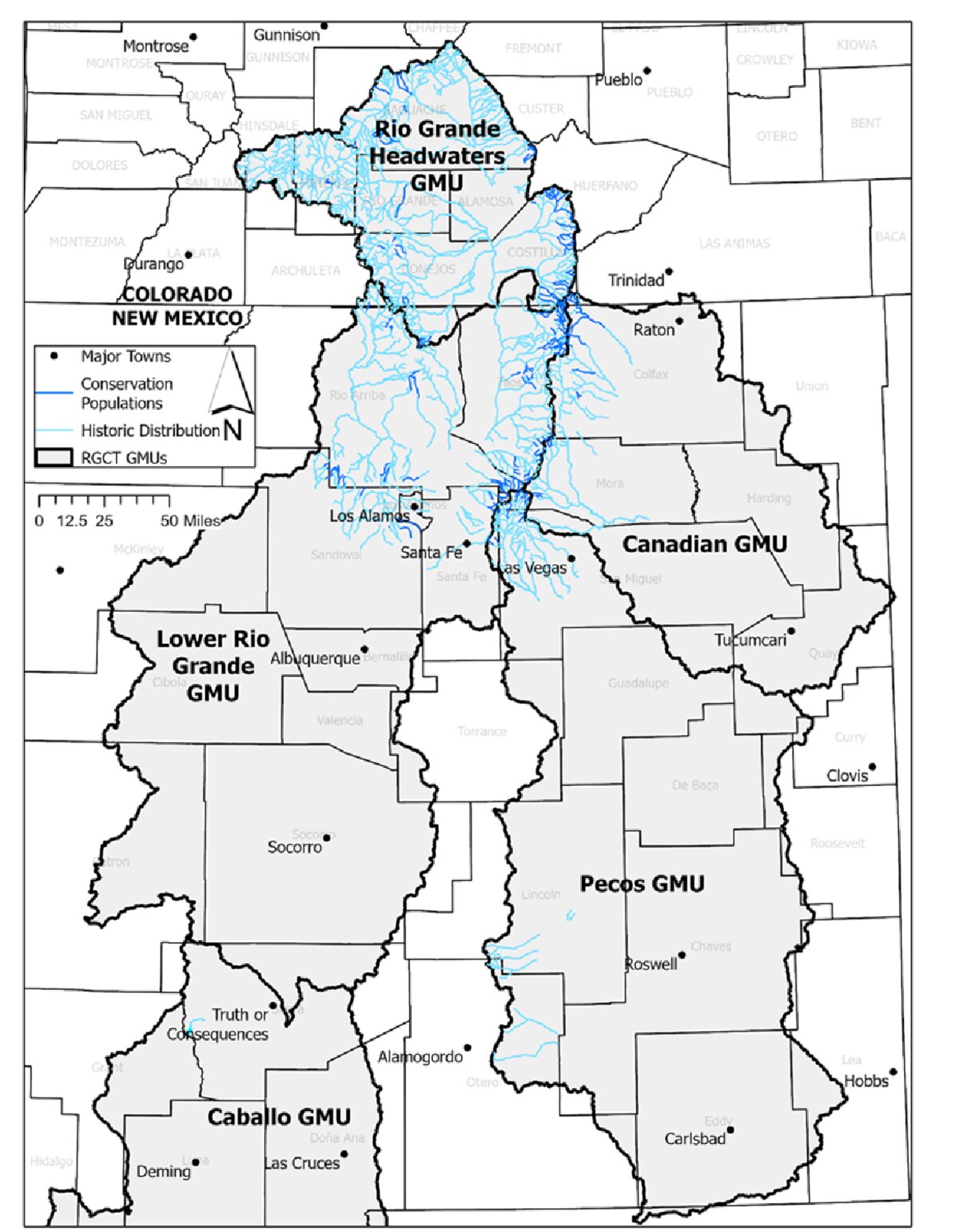
Nine populations on the Pecos
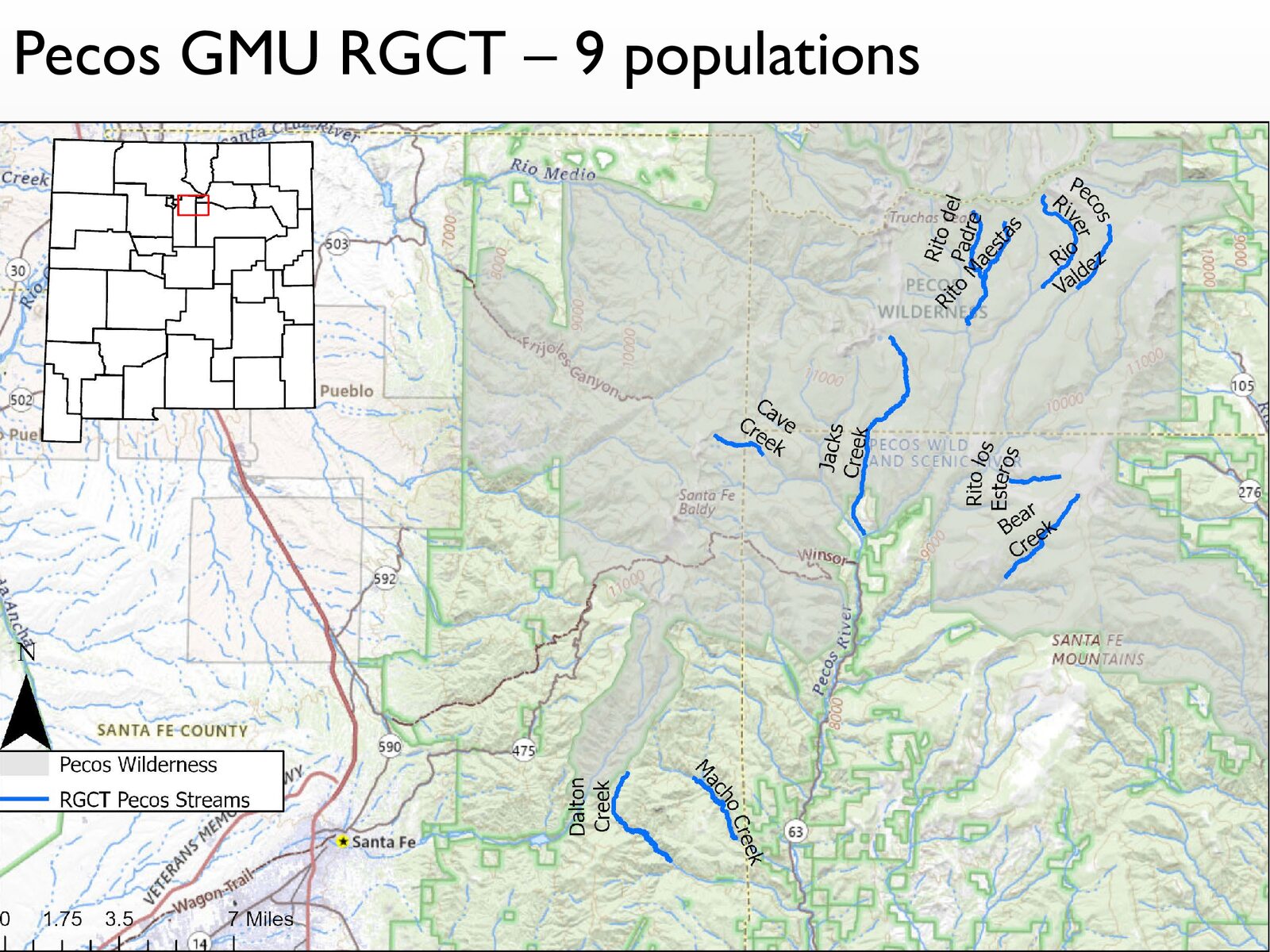
The Pecos unit holds nine populations across ten streams, since Rito Maestas and Rito del Padre are connected and count as one population. Bryan showed survey numbers for each. The measure is catch per unit effort, which is how many fish turn up for a set amount of survey work, so the numbers compare streams rather than count fish.
Jacks Creek, surveyed this year, came back at 182.5 cutthroat against 5.2 brown trout. Macho Creek in 2025 read 164.6 cutthroat and no browns. The Pecos River itself read 102.2 in 2023, Cave Creek 95.4 in 2020, Rio Valdez 27.6, Rito del Padre 22.7, Dalton Creek 9.3.
Then the hard ones. Bear Creek: 1.3 cutthroat, 186.7 brown trout. Rito los Esteros: 3.8 cutthroat, 184.3 brown trout. Rito Maestas: 0.17. Those are streams where the native fish is close to gone and something else is living in it.
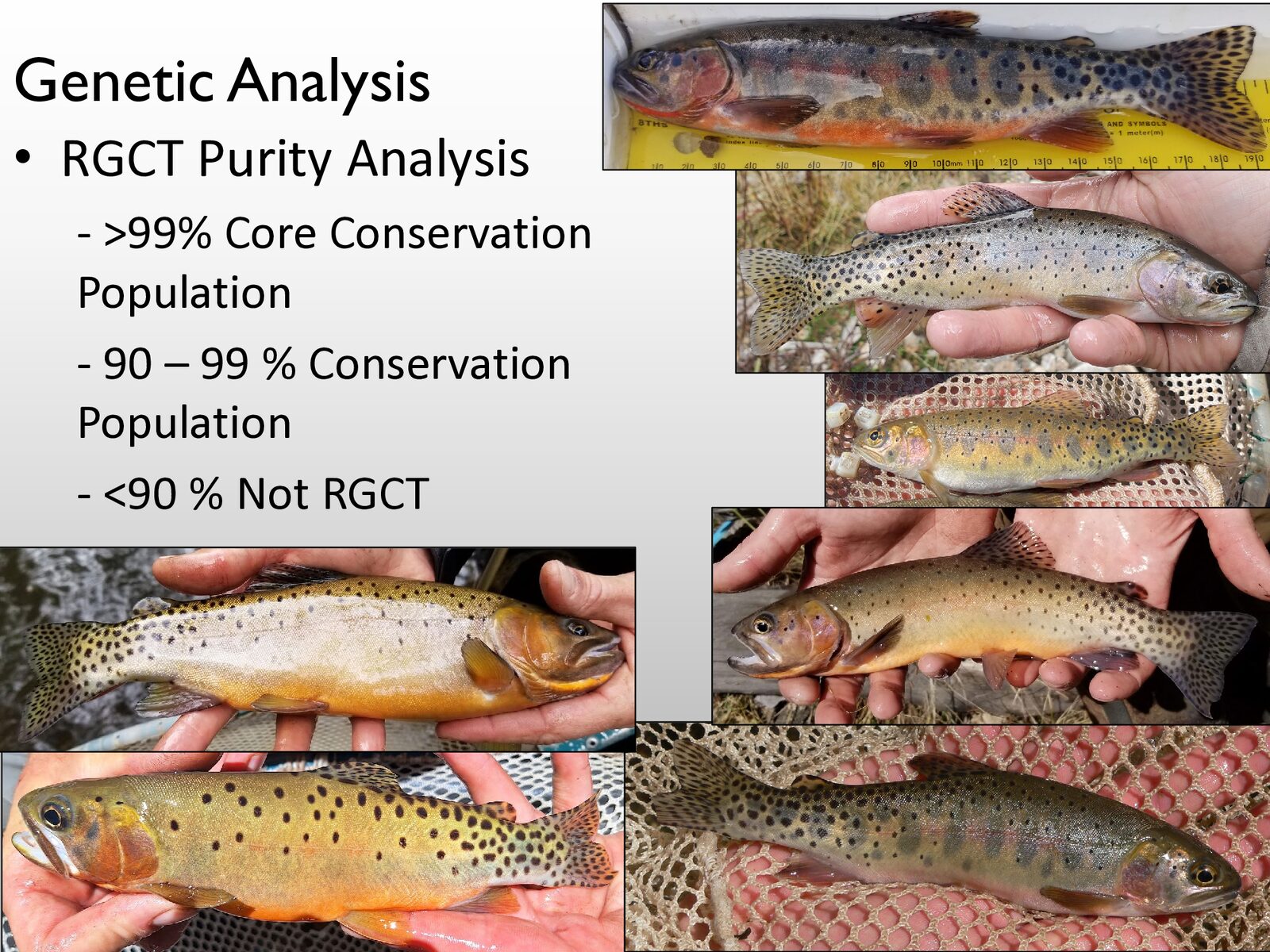
Genetics sort the populations too. Above 99 percent purity is a core conservation population, 90 to 99 percent is a conservation population, and below 90 percent the fish are not counted as Rio Grande Cutthroat Trout at all. Bryan put two charts side by side: Macho Creek, where every sample was solid cutthroat, and the Rio Nambe, where the samples were a mix of cutthroat, rainbow and Yellowstone cutthroat genes. Same species on paper. Not the same fish.
A first spawn, and fish going back in
The 2022 Hermits Peak and Calf Canyon fire nearly took Rio Valdez. On June 24 of that year, crews salvaged 114 cutthroat out of that stream ahead of the fire’s effects, and the survivors spawned in May 2023. Macho Creek contributed 15 pairs the same month.
Those fish became a Pecos broodstock at Seven Springs Hatchery: 500 Rio Valdez and 500 Macho Creek fish, now age three. They spawned for the first time in spring 2026 and produced about 50,000 fry. That is a Pecos-strain safety net that did not exist four years ago.
The restoration work is where those fish go.
- Willow Creek. Barrier built in 2020, nonnative trout removed by piscicide treatment in 2021 and 2022, then stocked: 1,100 age-0 fish in 2023, 900 yearlings in 2024, and 383 age-0 fish in 2025.
- Cow Creek. A natural waterfall does the barrier’s job here. Piscicide treatments in 2024 and 2025, then 223 age-3 cutthroat stocked last fall.
- Rio Mora. Natural waterfall barrier, and the cutthroat did not survive the fire’s effects. Three years of stocking are planned, beginning fall 2026.
- Tecolote Creek. The brook trout and hybrid cutthroat there did not survive the fire either. Habitat is recovering on its own in places, instream work is planned with the Forest Service and NMDOW, and stocking is planned behind it.
Jacks Creek, and the brown trout problem
Jacks Creek is the one to watch. Environmental DNA testing picked up brown trout above the waterfall in 2023. Crews pulled 7 adult browns out in 2024, then 1 adult and 18 young of the year in 2025, then 24 more so far in 2026, all of them three to four inches. Young fish in successive years means they are spawning up there, not washing in.
Engineering design and compliance are complete for a fish barrier above NM 63. Meanwhile the regulations on Jacks Creek do what they can: catch and release on cutthroat, unlimited bag on rainbow, brook and brown trout. If you fish it, keeping the browns is the conservation move.
Where to go find one
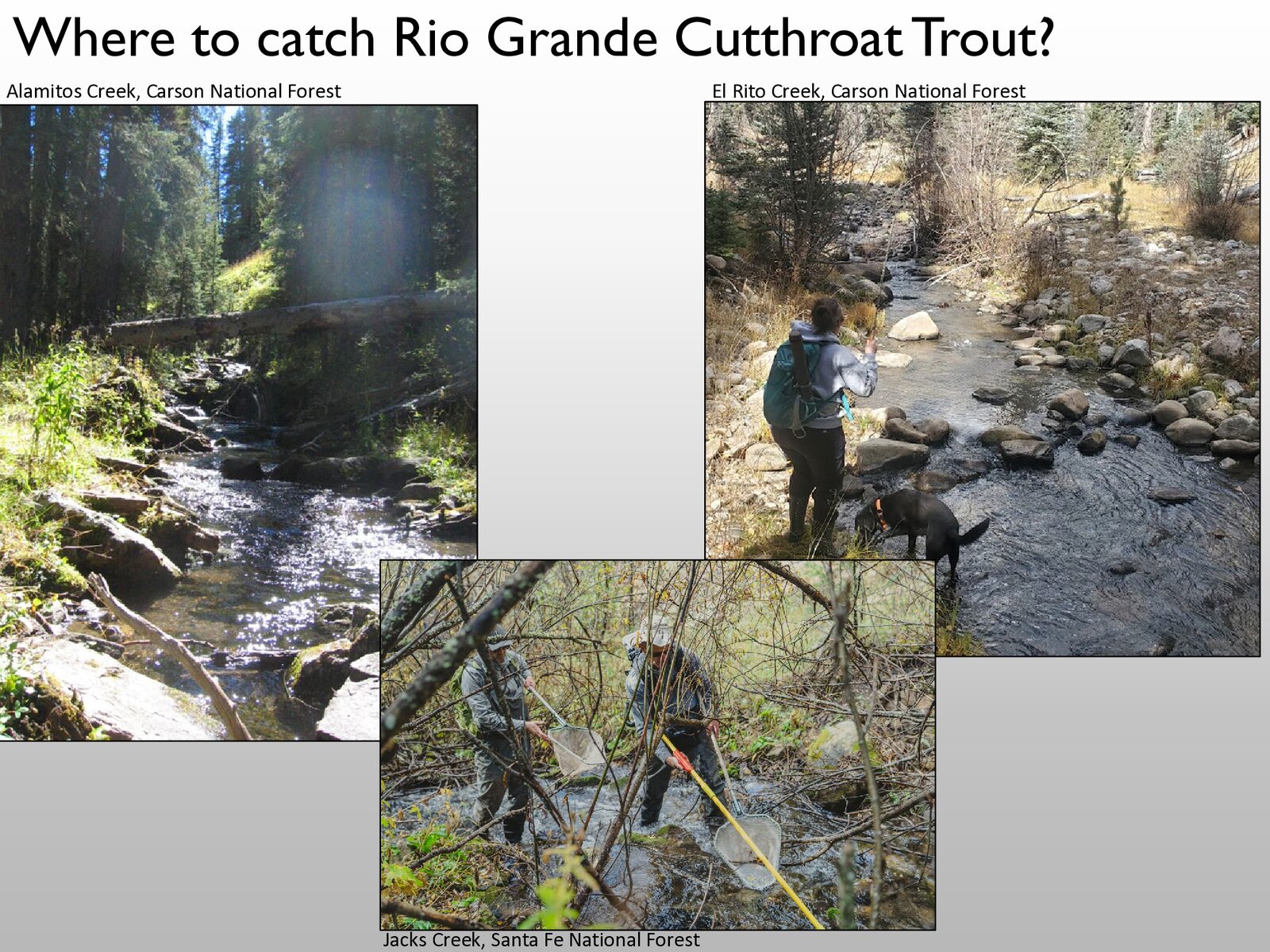
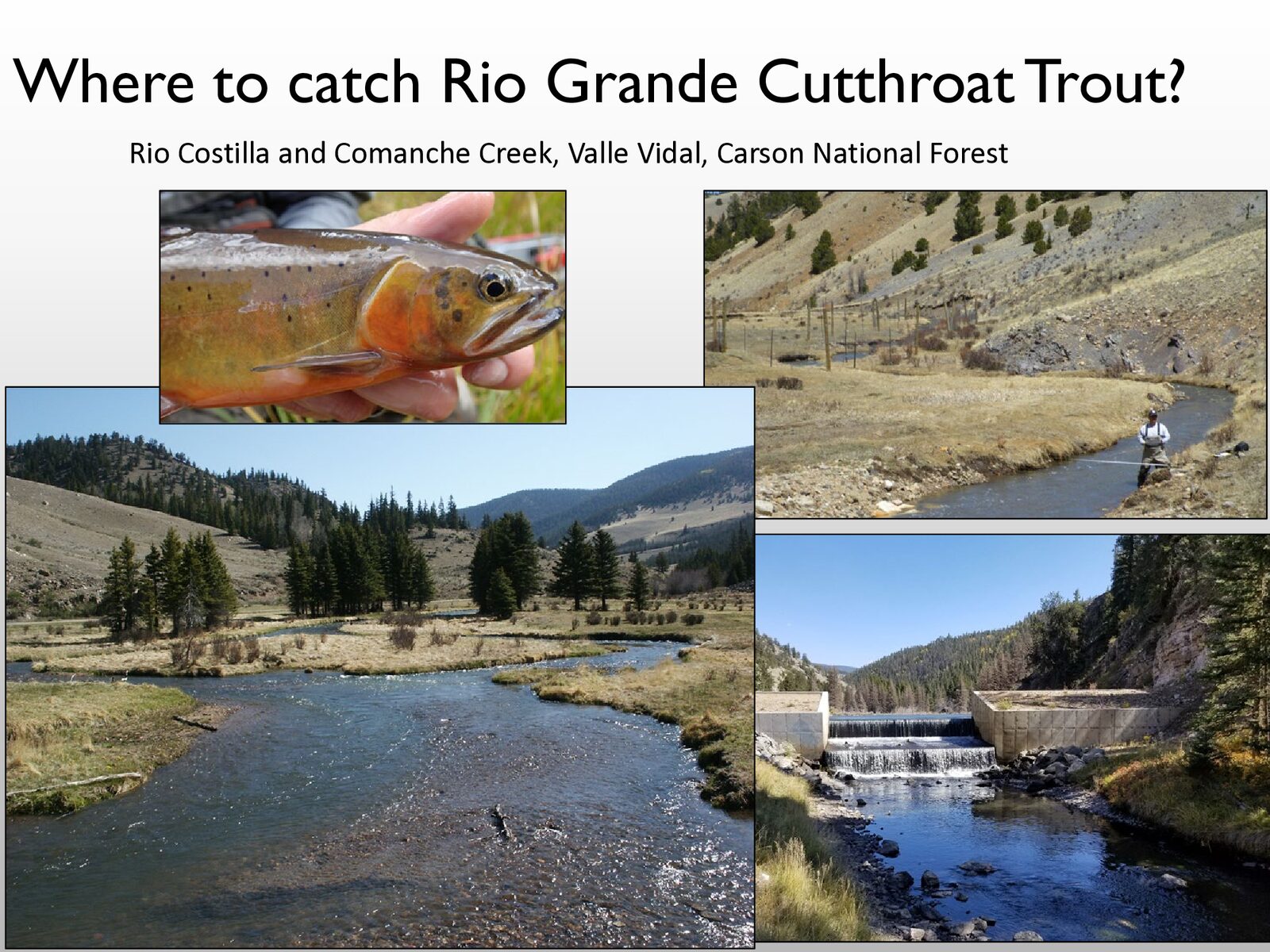
Bryan’s own list: the Rio Costilla and Comanche Creek in the Valle Vidal, Alamitos Creek and El Rito Creek in the Carson National Forest, and Jacks Creek in the Santa Fe National Forest. The department also stocks cutthroat recreationally in a long list of waters, among them Canjilon Lakes, the Cebolla and Chama rivers, the East Fork of the Jemez, Fenton Lake, the Guadalupe River, Hopewell and Horseshoe lakes, Trampas Lakes and the Rio Grande gorge. Check the current rules for the reach you plan to fish before you go.
Two things he asked us for
He asked the chapter for help with education, specifically on why cutthroat belong here and why nobody should ever move fish between waters. Bear Creek and the Rio Nambe are what moving fish looks like a few decades later.
And he asked for reports. If you catch a brown trout above a barrier, tell him. That is real data on whether a barrier is holding, and anglers cover more water than crews do. Reach him at [email protected] or 505-412-3627.
Our thanks to Bryan for the evening, and for staying through our board meeting afterward. If you want to put hands on this work rather than read about it, our volunteer roundup is the place to start.