
Editor’s note: In this guest article, Daniel Gibson reports from the remote Rito Chihuahueños drainage in the Jemez Mountains, where volunteers with Trout Unlimited are helping restore stream and wet meadow habitat for native Rio Grande cutthroat trout. The piece is based on the author’s participation in a two-day restoration effort.
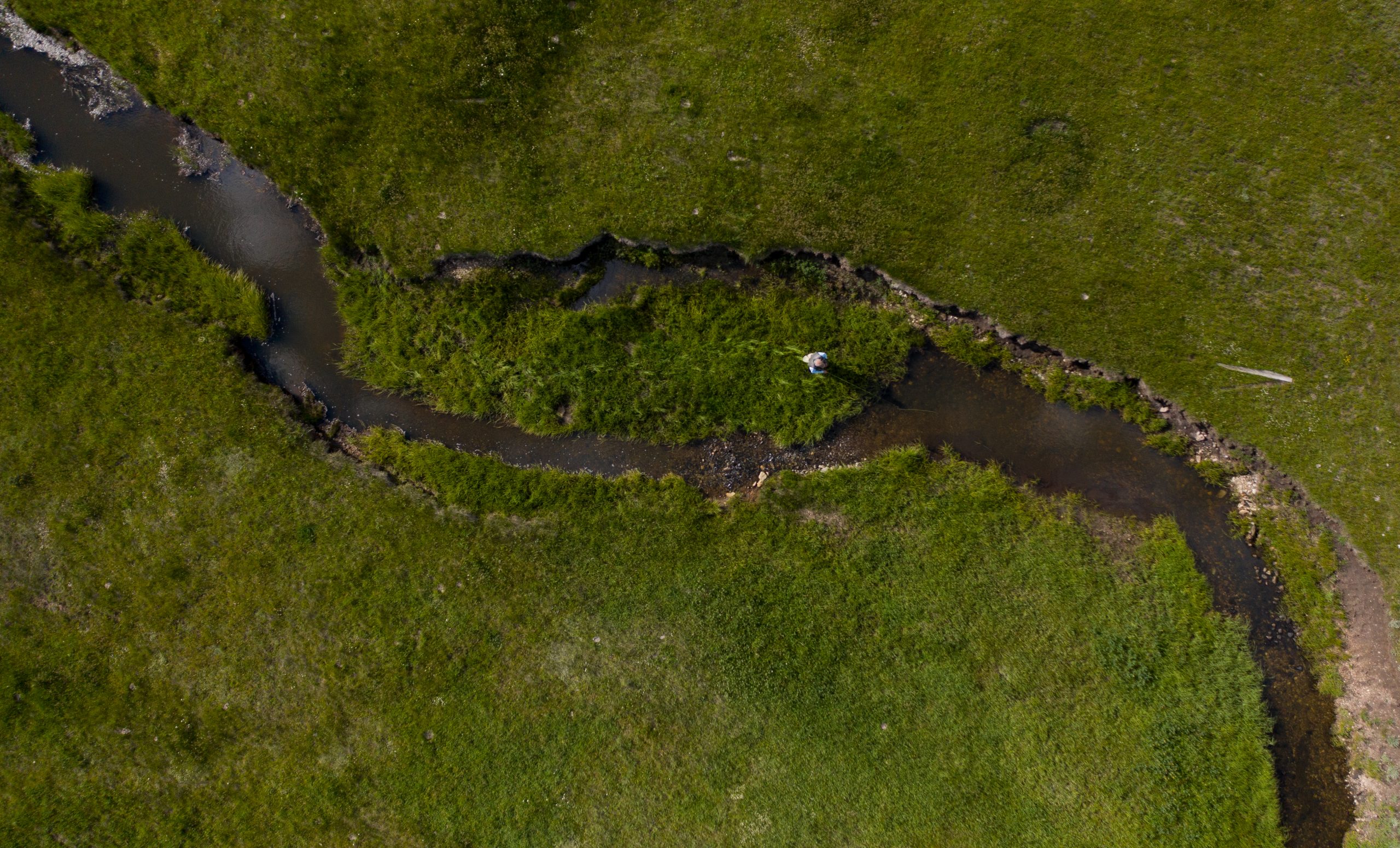
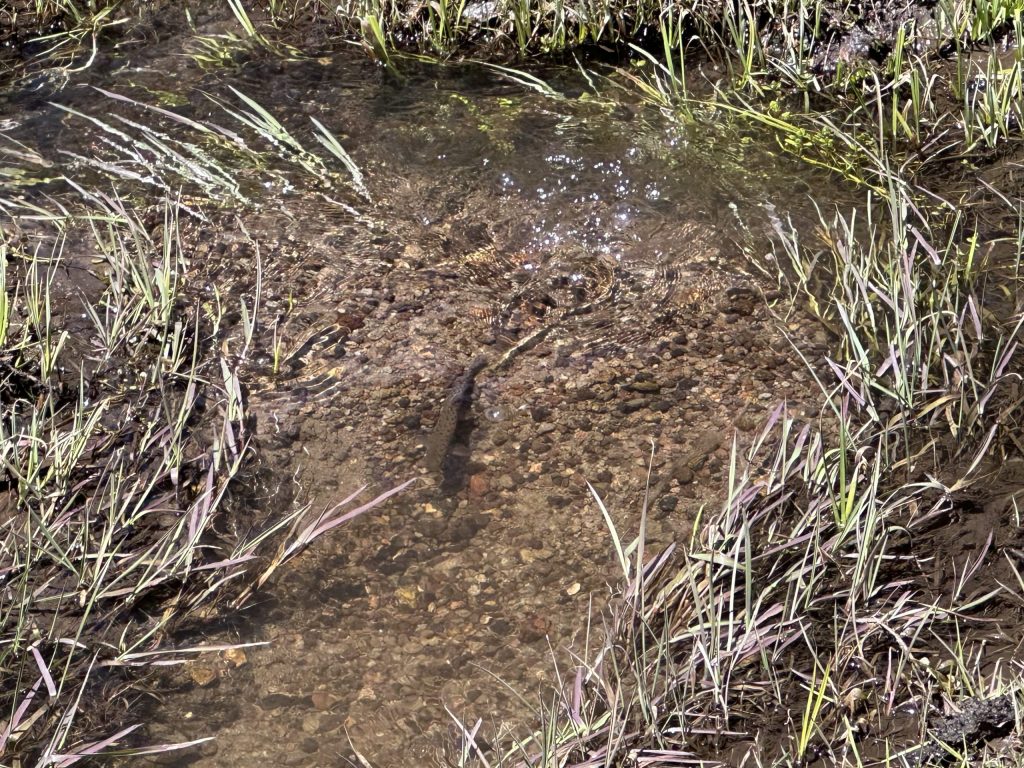
It hardly seems like they should be here at all, but high on the north slope of the Jemez mountains we find a “stream” less than a foot wide harboring a sizable population of native Rio Grande cutthroat trout.
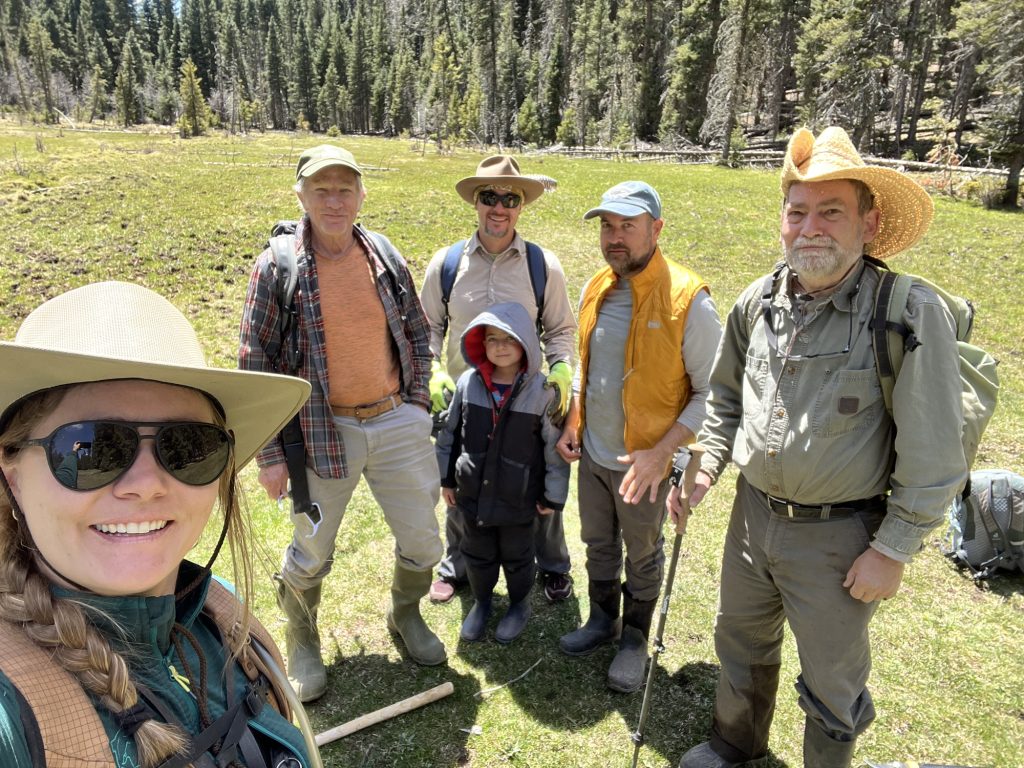
A crew of five volunteers led by Trout Unlimited’s Northern New Mexico Project Manager Juliet Smith was on site in late April to undertake stream and wet meadow restoration efforts to ensure this remnant population of endemic trout will not blink out in the coming heat of summer and general climate change.
We had spent the day before at a site some 3 miles down the steep-walled valley carved by the Rito Chihuahueños planting willow shoots alongside the trickling cow-stomped waterway. To think that the head of the valley might harbor a living trout population seemed preposterous. So, it was with delight the next day when we found dozens of small cuts dashing around behind log structures placed into the creek bed by previous TU work crews. Those jumbles of logs and pine limbs were clearly working: trapping sediment, holding back water, and creating habit for the imperiled trout.
The two-day outing had begun at a forest service road just outside of the small village of Youngsville, just north of Abiquiu Dam. We caravaned southeast for almost 90 minutes, burrowing some 28 miles of dusty, rocky and timber-strewn roads into a very remote sector of the Jemez. Climbing steadily, we passed through some huge, largely dry meadows, spotting the first brilliant, lime-green leafing aspen of the year. Off to one side sped four female elk, and some turkeys waddled away quickly, seeming to know it is hunting season.
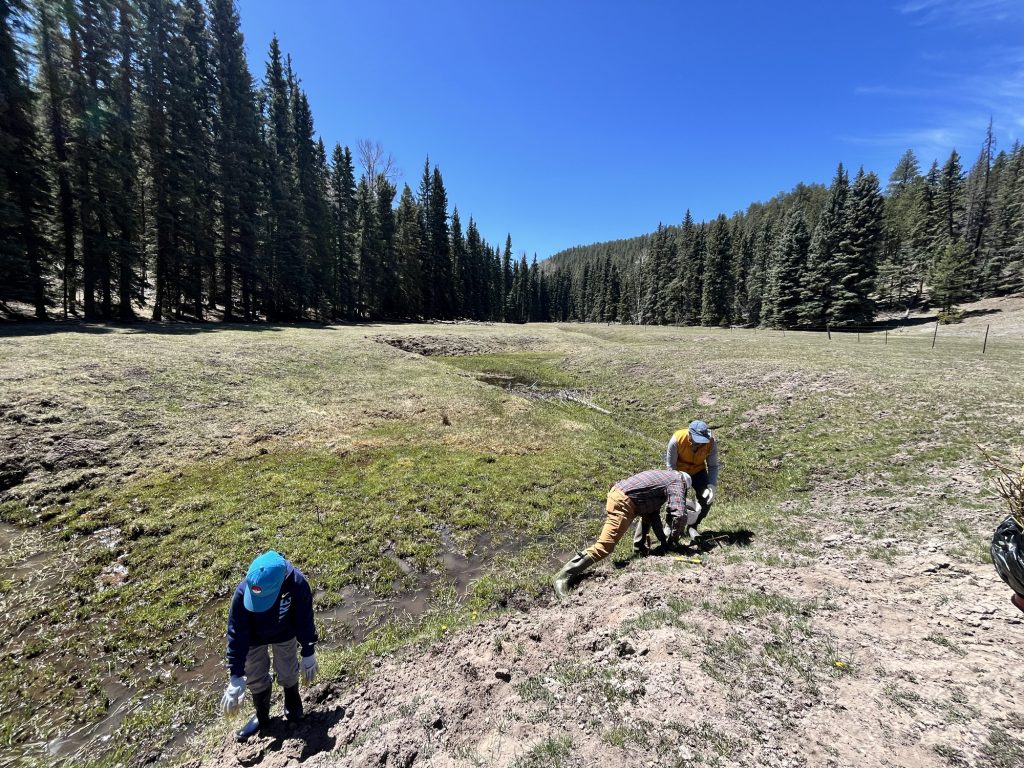
We finally ground to a halt in the Chihuahueños valley, and unloaded gear and the tender willow cuttings or “poles.” These measured a foot to two feet in height, and from baby finger diameter to ring finger size. They had been harvested some weeks prior from another valley in the north Jemez at similar altitude. They’d been placed in five-gallon buckets of water to promote root emergence, covered with black plastic to slow down leaf germination and stored in an unheated adobe building. We carried these bucket, holding some 1,000 cuttings, a few hand tools, and our lunch up the valley about a half mile to a long meadow. Here Santa Fe National Forest personnel had erected two barbwire fence enclosures boxing in about a half mile of the stream, and we began to plant the willow cuttings alongside the thin ribbon of water. While elk can hop the fences, it is hoped that the enclosure can keep out the ubiquitous cattle that would otherwise eat the tender willow shoots or trample them.
A Forest Service hydrologist, Kevin Carns, accompanied us this first morning, as all TU projects in the national forests must have the blessing and supervision of the USFS. There are beaver downstream and he noted, “If we prime the pump and set the stage for beaver to move in, they will reappear on their own. He went on to say, “We are so appreciative of the TU efforts, their ability to source funding and to manage projects on a scale that we can make some meaningful change.
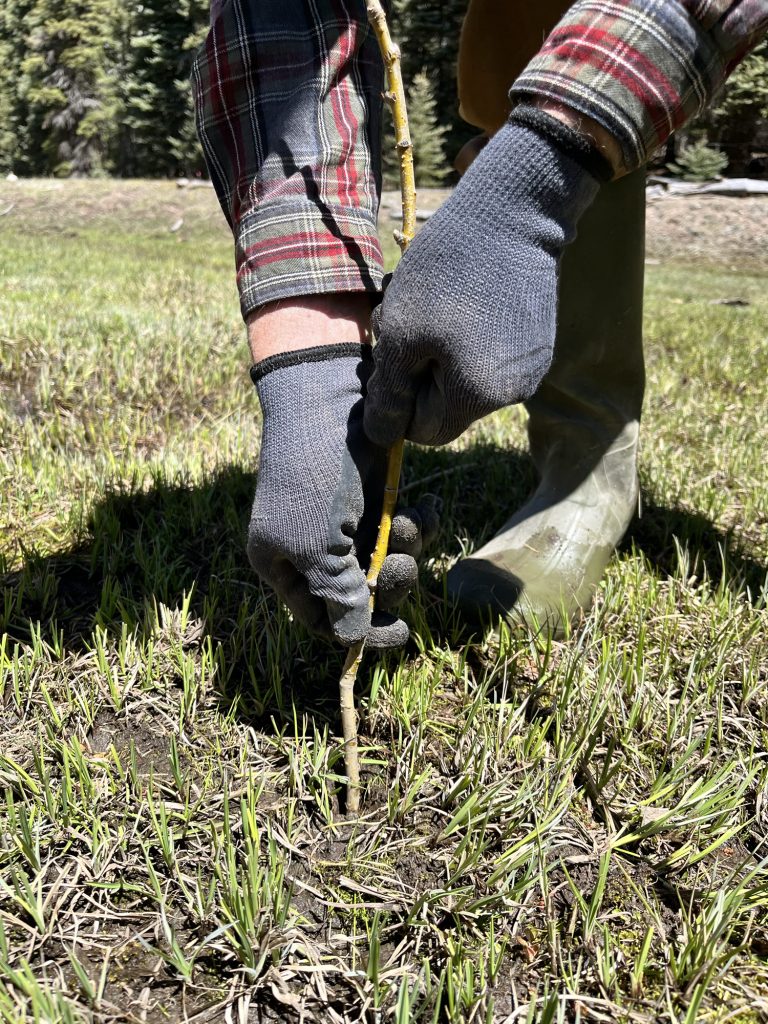
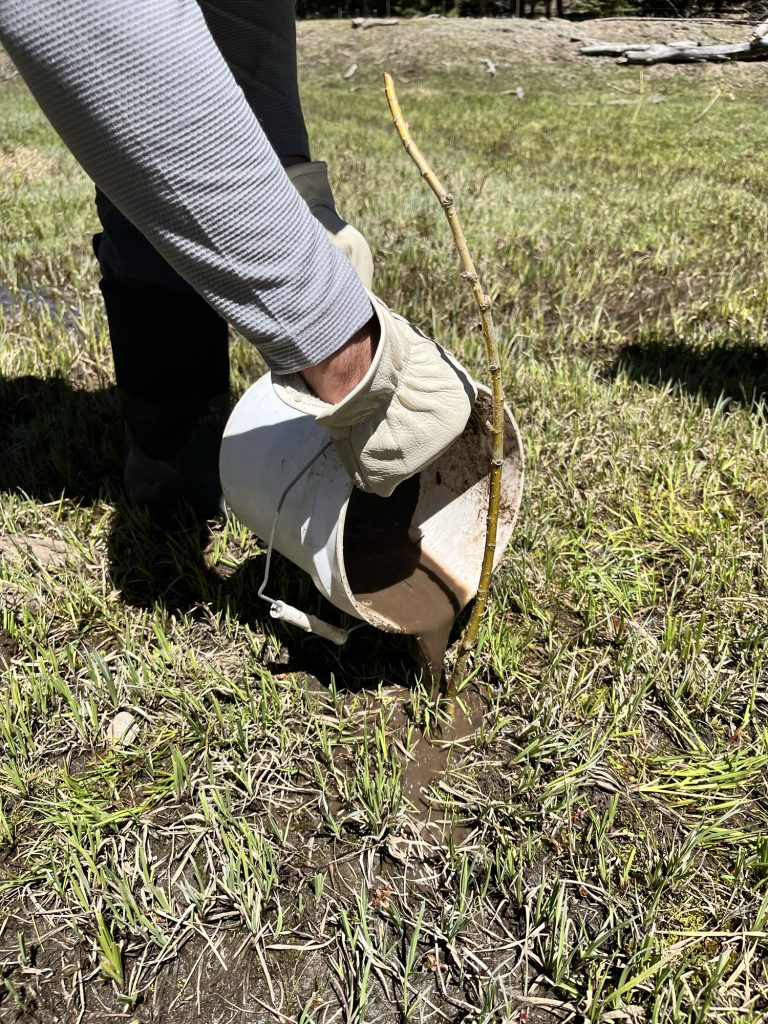
Some five hours later, our backs aching from the effort, we’d completed the plantings, and headed back to our vehicles, where we set up tents to camp out. Juliet soon had stoves going and hot food on the way, and we got to know one another. Oddly, it turns out all four adult volunteers are writers of one sort or another, so we enjoyed swapping publishing tales and personal histories. Then, before it was dark, we bid goodnight and headed to welcome sleep.
The next morning broke cold at our elevation of 8,600 feet in the shade of huge Douglas fir, foxtail pine, blue spruce and aspen trees. But hot coffee awaited us from Juliet, and delicious toasted bagels with fried eggs and sausage. Fueled up, we packed up and drove 30 minutes or so towards the upper valley. A descent on foot of about 500 vertical feet over a mile or so brought us into a huge open meadow at an elevation of about 9,200 feet just below the headwaters of the Chihuahueños.
Here the creek ran with much greater volume and velocity than in the lower valley, but still less than a foot wide and a foot or so in depth. Walking up valley we soon came to the first of the log structures TU had placed in the creek about a year earlier, and found our first cluster of trout. We continued walking up valley, spooking even smaller trout at almost every likely hole or overhung bank. Walking even higher, we reached the top of the defined stream channel and entered what is called a “wet meadow.” Here the creek devolved into a complex of braided tiny rivulets, and saturated, spongy ground. The day’s assignment was to cut small diameter pines encroaching on the meadow, and use their boughs to clog the larger rivulets to encourage the water to fan out across the landscape. This would ensure the top of the valley would hold additional tons of water, slowly releasing it to the creek below. This obviously benefits, and is essential, to the trout, but also will help deliver water to the acequia systems of the small farming villages at the foot of the mountains.
The TU project in this isolated valley covers some 4.5 miles in total. It is hoped that with future installation of log structures, and the plating of more willows that provide shade to the waterway, reducing evaporation and high water temperatures, that one day trout will reoccupy the entire stretch, and even move downsteam out of the work zone. Ideally, it will become so attractive that beaver will return to the desiccated waterway, and with their phenomenal hydroengineering, restore the stream to full ecological vitality. One can only hope, and work towards that exciting possibility. One willow cutting and one log at a time.